Sunday, 17 March 2013

Luck of the Irish


As I wish everyone a Happy St. Patrick’s Day, I cannot think of a better place to write about today than the emerald island of Ireland.  While I was not visiting during the past weekend, I recently met up with a couple friends to enjoy what the city of Dublin has to offer.  With a vibrant nightlife and one of Europe's most youthful cities, Dublin is the capital of Ireland, and the economic center of the country.  Just south of the River Liffey lies Dublin’s cultural quarter, known as Temple Bar.  The Temple Bar area, with its medieval street pattern and cobbled stone streets, has a lively nightlife with multiple bars and restaurants.  

Ireland has a unique history with during a period of political and economic decline, the government was transferred to the United Kingdom at the start of the 19th century.  After subsequent attempts to reclaim their independence, it was not until Irish Civil Ware that the Anglo-Irish Treaty established a “free state” (not a republic) in December 1922. The treaty provided for a self-governing Irish state in 26 of Ireland's 32 counties, with the remaining six northeastern counties opting to remain part of the United Kingdom as Northern Ireland (to be written in a separate entry).  Even after the signing of the treaty, the Irish society was left divided and embittered.

Kilmainham Gaol played an important part in Irish history, as many leaders of Irish rebellions were imprisoned and some executed in the prison by the British and in 1923 by the Irish Free State.  Built in 1796, public hangings originally occurred at the front of the Gaol for all to witness.  Since the prison was seen principally as a site of oppression and suffering in the struggle for national independence, Kilmainham Gaol was decommissioned by the Irish Free State government in 1924.

Finally, no trip to Dublin is complete without visiting the most popular tourist attraction is St. James's Gate Brewery. Originally leased in 1759 to Arthur Guinness for 9,000 years, St. James's Gate was the largest brewery in the world up to 1914 and has been the home of Guinness.  Now a Guinness museum, incorporating elements from the old brewing factory to explain the history of its production, you are still able to see the old brewing equipment, as well as stout ingredients, brewing techniques, creative advertising methods and storage devices.  The final floor is the Bar, which has a panorama view over the city of Dublin, and where visitors can claim a free pint.

Outside of Dublin and rising almost 700 feet above the Atlantic Ocean on southwestern edge of County Clare, Ireland, you will find the Cliffs of Moher.  An estimated 1 million people per year visit the cliffs to enjoy wonderful views of 300 million year old shale and sandstone formations.  An estimated 30,000 birds live on the cliffs, representing more than 20 species.  The one place I did not get a chance to see was the famous Blarney Stone, which I will have to try another time.
Just in case you need a reminder of the drop
Ironic - The Guinness Medical Department
Temple Bar
Gaol prison where some of the executions occurred

Friday, 1 March 2013

“Wal-mart” of the Sky


Traveling in a pressurized tube more than 33,000 feet above the ground, the familiar warning announcement of no smoking while on board the plane came loud and clear through the speakers.  Still, I debated seeking the attention of the flight attendant passing down the aisle selling duty free packs of cigarettes on board the plane.  With such a great deal walking through, it was tempting to not let this opportunity pass me bye.  However, I did pass only to wait for the next flight attendant who was selling scratch off tickets.  In an industry of unprofitability and cut-throat competition, Ryan Air has mastered the add-on fee and raised new proposals to save money and deliver low cost fares to customers.  Apart from introducing a charge for oxygen when the pressure masks fall or tactics like circulating the smell of popcorn through the air to stir an appetite, Ryan Air has been the most talked about airline for introducing cost-saving ventures, and it was now time for me to experience first hand why 80 million passengers per year choose to travel with Ryan Air.

Searching for a flight to visit Dublin for a weekend, I came across an extremely low fare from Ryan Air.  After selecting the flights, I was then asked if I would like to purchase additional travel insurance and check luggage, which I declined.  Then an offer for a text message, followed by Ryan Air talk, an airport transfer, and finally, an offer to purchase actual luggage.  Proceeding to the next page had another offer, “Play to Win”, which for 3 Euro, I could be entered to win back the cost of my flight.  After finally given the chance to enter my credit card information, for an additional fee, and because the site recognized I had a US address, an offer for a “guaranteed” exchange rate of 10% higher than the actual rate which Ryan Air highly recommended, I was finally able to purchase my ticket.  Additional offers for hotels, meals, and tours followed once my ticket was confirmed.  And, as part of Ryan Air’s policy, you must check-in online and print your boarding pass prior to arriving at the airport.  Should you forget to check in, or lose your boarding pass, you will be charged an additional 60 Euro.  To ensure you did not make an error earlier when booking, as you check in for your flight, you go through the same tempting offers as you did when you paid for your flight.


Arriving to the airport about 1 hour before my flight, with my boarding pass in hand, I lined up to board the plane.  Under a very watchful gate attendant, each bag was checked to ensure it was proper size, or else an additional checked baggage fee would apply.  Boarding the plane was by far the quickest and most efficient process I have even been apart of.  Boarding a jet parked away from the gate, using both the front and rear doors, and no assigned sears, it took just under 15 minutes to board and we were up in the air in no time.  While you are constantly bombarded with offers to purchase items, or advertisements on the overhead bins and seat backs, the airline met my main objective, which is take-offs equals landings (proper landings as water landings do not count).  Ryan Air is an extremely popular travel option within Europe, and very convenient from the Bratislava airport.  Fliers willing to tolerate a little hardship and potentially high fees if the rules are not followed will find very reliable travel options.  As one of the only profitable airlines around, and with packed planes, it is hard to argue against their business model.

Finally, I cannot complete this entry without mentioning other ideas proposed by Ryan Air. 

1. To flight rising fuel costs, Ryan Air introduced proposals to lighten its load. Magazines featured thinner paper, safeties manuals were printed on the back of each seat, and even carried less ice on board.  But those marginal changes are benign compared to Ryan Air's weight-reducing proposal: Encouraging flight attendants to shed excess pounds.

2. After initially proposing coin-operated bathrooms, Ryan Air then considered replacing two of the three restrooms installed on each jet with six additional seats.  As quoted by the CEO, "We very rarely use all three toilets on board our aircraft anyway".

3. With a constant focus on passenger safety, Ryan Air suggested that the flight attendants be trained to fly.  While this sounds like a fantastic proposal, it was suggested to mitigate the risk of flying the plane with only one pilot meaning that the standard allotment of two pilots per plane is one too many.  In this case, if the computer was not able to set in to fly the plane, the flight attendants could step up in cases of emergency.

4. Naturally luggage adds a lot of pounds to any aircraft, and to recover some costs, many airlines have begun charging fees to limit weight and promote carry-on only bags. Ryan Air took it one step further by suggesting that passengers haul their check-in luggage to the plane's belly, to save the airline the costs of paying baggage handlers and check-in personnel.

5. Finally, spending a couple of hours crammed in an airplane seat, with the seat in front of you reclining into your face, and passengers using your seat as an assistant to help stand and balance, is no one's idea of fun.  Why not eliminate standard seats in favor of standing-only "berths"?  Instead of seat belts, Ryanair proposed passengers would use "handrails and straps" to secure themselves, thus removing last 10 rows of seats and replace with 15 rows of standing berths.

Monday, 28 January 2013

Exploring Egypt


As if I thought my 2 AM wake up call the prior week was the earliest I would ever get up, the German tourists making their way back to their rooms from the bar at 12:40 AM provided a sufficient alarm, five minutes before my scheduled wake up call at 12:45 AM.  I do not even think it is right to call 12:45 AM a wake up call, but rather more of a nap.  The phone rang shortly after I awoke; I was ready to begin my six hour journey by bus to Cairo.

Located near the Nile Delta, in the area known as lower Egypt (I will mention why later), Cairo is the city in Africa with a population over 9 million people. Founded in 969 AD, and nicknamed "the city of a thousand minarets" for its preponderance of Islamic architecture, Cairo has long been a centre of the region's political and cultural life.  The recent demonstrations occurring in Tahrir Square today (same site two years ago) occurred after I had visited a couple months ago.

On the outskirts of Cairo, with the city providing an interesting comparison of the new world and old world, you will find the oldest of the Seven Wonders of the Ancient World, the pyramids of Giza.  There are 138 pyramids discovered in Egypt as of today, and were built by 20,000 workers (and up to 100,000 in some cases) as tombs for the country's Pharaohs.  The Great Pyramid (or Pyramid of Khufu) was the tallest man-made structure in the world for over 3,800 years. Originally, the pyramids were covered by casing stones that formed a smooth outer surface; what is seen today is the underlying core structure.  The shape of a pyramid is thought to be representative of the descending rays of the sun, and most pyramids were faced with polished, highly reflective white limestone, in order to give them a brilliant appearance when viewed from a distance.

Adjacent to the Great Pyramids of Giza lays the largest and most famous sphinx.  The Great Sphinx of Giza is a mythical creature with the body of a lion and the head of a human.  Egyptologists have proposed numerous theories surrounding the date the sphinx was completed and the method of construction used; however, it may always remain an unanswered question.  The pyramids and sphinx are very nice to see, however, more must be done to maintain their existence in history and for everyone to enjoy as people are constantly climbing on the pyramids, and with the constant bombardment of items to purchase, it takes away from the true meaning of the site.

Located just over 300 miles to the south in Upper Egypt is the city of Luxor.  The terminology of “Upper” and “Lower” Egypt derives from the flow of the Nile from the highlands of East Africa northwards to the Mediterranean Sea, thus Upper Egypt lies to the south of Lower Egypt (even though geographically it is the opposite).  Luxor was the ancient city of Thebes, the great capital of Egypt during the New Kingdom, and the glorious city of the god Amon-Ra.  Luxor has frequently been characterized as the "world's greatest open air museum", as the ruins of the temple complexes at Karnak and Luxor stand within the modern city.  Build from sandstone, Luxor Temple is the large Ancient Egyptian temple complex located on the east bank of the Nile River in the city today known as Luxor and was founded in 1400 BC. 

Crossing the Nile
Immediately west, across the River Nile, lie the monuments, temples and tombs on the West Bank Necropolis, which include the Valley of the Kings and Valley of the Queens.  With the sun rising in the east, and setting in the west, the tombs of the dead were built into the west side of the city in mountains to symbolize death and the power of restoring life by giving immortality to the dead owner.  Many years could be spent on building and preparing tombs, some of which went incomplete as the future occupant might have died prior to completion.  The art work and paintings in the tombs is beautiful, and very well preserved, most likely due to the dry, desert climate. Also, the art technique used was known as egg tempera, which a color pigment was mixed with egg white (or yolk depending on the desired effects) which resulted a mixture that was fast drying and permanent.

Saturday, 29 December 2012

Relaxing in the Red Sea


Feeling as if my heavy head had just hit the soft pillow, alarm bells rang for my earliest wake up call that I can remember.  The clock had just struck 2AM, and it was time to depart for Vienna for my four hour flight to the Red Sea city of Hurghada, Egypt.  One small observation, with the flight being operated by Niki Air (part of Air Berlin/One World), I thought it was odd the Niki’s mascot is a fly.  With most airlines choosing a bird or country specific emblem (a shamrock for Air Lingus or tropical dancer for Hawaiian Airlines), I have no clue why Niki would choose an annoying insect as their route to market.  But the airline is friendly, the food is good, and the flights were on time.

Egypt is home to 82 million people, and an interesting point of reference is that 98% of the population resides on 3% of the land.  Being that the country is predominately desert, the observation is probably not shocking, but the low land percentage is surprising.  From the air, you can definitely sense that the Nile River is the source of life for many, as seems that the only source of green vegetation was on the banks of the river.  Bordering Libya to the west, Sudan to the south, the Mediterranean Sea and Gaza to the north, and the Red Sea to the East, with Saudi Arabia just across, there was always a sense of nervous feelings in the air.  However, within the walls of the resort, you felt like this was paradise. 

Upon arriving in the airport (where I received a second look from passport control), and a short 30 minute bus ride through the deserts and along the mountains, finally coming to a stop in secluded area which housed 500+ rooms, 5 restaurants, 3 large pools (although they were too cold for me at 22/70 degrees), multiple bars, and lots of ice cream, I was definitely looking forward to a relaxing time.  With any time to a foreign country, you must always be careful what you eat and drink to order to not spend your entire trip trapped in your hotel room.  Apart from drinking bottled water (even for brushing) and no ice ever, my recommendation is to eat as unhealthy as you possibly can.  Leave the fresh fruits (bananas are ok because they must be pealed) and salads to the side, and select the fries, burgers, eggs, and noodles…basically anything that has been cooked.

With the temperature hovering around 27 (80s) all week, the sea was 24 degrees, and while it was too cold for the dolphins, it was just perfect for me.  Apart from sun and fun, one of the main tourist attractions of the Red Sea is the amazing coral life.  You definitely need a pair of water shoes as the coral is very hard and sharp.  After walking about 100 yards from the shore through the waist deep sea, you breath is taken away by the 40 foot drop covered with numerous and colorful marine life.  I struggled to keep pace with the small sting ray that blended in very well with the sea floor while the dark and elusive moray eel remained hidden within the coral, finally slithering through the rocks in search for some peace and quiet.

A week in the Red Sea was exactly what I needed to relax from the hustle and bustle of work, and to look forward to 2013.  

Sunday, 2 December 2012

When in Rome


“My name is Maximus Decimus Meridius, commander of the Armies of the North, General of the Felix Legions, loyal servant to the true emperor, Marcus Aurelius. Father to a murdered son, husband to a murdered wife. And I will have my vengeance, in this life or the next" said Russell Crowe in while standing in the middle of the Roman Colosseum.  The Colosseum, build of concrete and stone, is considered one of the greatest works of Roman architecture and engineering.  Occupying the site just east of the Roman Forum, construction began in 72 AD, and took 8 years to complete.  Capable of seating 50,000 spectators, the Colosseum was used for gladiatorial contests and public spectacles such as mock sea battles, animal hunts, executions, re-enactments of famous battles, and dramas based on Classical mythology. It was later reused for such purposes as housing, workshops, quarters for a religious order, a fortress, a quarry, and a Christian shrine.  The majority of the Colosseum has withstood the test of time, even through fires and earthquakes, however parts of the outer south side, lying on a less stable terrain, collapsed. Much of the tumbled stone was reused to build palaces, churches, hospitals and other buildings elsewhere in Rome.

Roma (Italian) is the capital of Italy with 2.8 million residents is the fourth-most populous city in the Europe, and consistently in the top 15 most visited cities in the world.  Built on seven hills on banks of the Tiber River and numerous stories have been handed down by generations as to the legends and myths of the city. Perhaps the most famous of all Roman myths, is the story of Romulus and Remus, twins who were raised suckled by a she-wolf after being thrown into the Tiber River by a relative. Upon being raised by the wolf, the boys decided to build a city, but after an argument, Romulus killed his brother. The Capitoline Wolf sculpture depicts a tense, watchful animal, with alert ears and glaring eyes watching for danger. By contrast, the human twins are oblivious to their surroundings.

The Roman Forum was the rectangular plaza surrounded by the ruins of several important ancient government buildings at the center of the city of Rome. For centuries, it was the center of Roman public life: the site of triumphal processions and elections of Sulla, Julius Caesar and Augustus, criminal trials, and nucleus of commercial affairs. Located in the small valley between the Palatine and Capitoline Hills, the Forum today is a sprawling ruin of architectural fragments and intermittent archeological excavations attracting numerous sightseers.

Moving across Rome, The Pantheon was build as a temple to all the gods of Ancient Rome, and rebuilt by Emperor Hadrian in about 126 AD after being destroyed by a fire.  The building is circular with a portico of large granite Corinthian columns under a pediment. A rectangular vestibule links the porch to the rotunda, which is under a coffered, concrete dome, with a central opening to the sky. Almost two thousand years after it was built, the Pantheon's dome is still the world's largest unreinforced concrete dome. The stresses in the dome were found to be substantially reduced by the use of successively less dense aggregate stones, such as small pots or pieces of pumice, in higher layers of the dome. If normal weight concrete had been used throughout, the stresses in the arch would have been some 80% greater.  It is one of the best-preserved of all Roman buildings. It has been in continuous use throughout its history, and since the 7th century, the Pantheon has been used as a Roman Catholic church dedicated to "St. Mary and the Martyrs" but informally known as "Santa Maria della Rotonda.". The square in front of the Pantheon is called Piazza della Rotonda.

Nearby The Pantheon, the Spanish Steps are a set of steps in Rome, Italy, climbing a steep slope between the Piazza di Spagna at the base and Piazza Trinità dei Monti, dominated by the Trinità dei Monti church at the top. The Scalinata is the widest staircase in Europe.  The monumental stairway of 138 steps was built linking the Bourbon Spanish Embassy, and the Trinità dei Monti church, both located above, to the Holy See in Palazzo Monaldeschi located below. The stairway was designed by architects Francesco de Sanctis and Alessandro Specchi.

The Fontana dei Quattro Fiumi or "Fountain of the Four Rivers" is a fountain in Rome, Italy, located in the urban square of the Piazza Navona. The base of the fountain is a basin from the centre of which travertine rocks rise to support four river gods and above them, an ancient Egyptian obelisk surmounted with the Pamphili family emblem of a dove with an olive twig. Collectively, they represent four major rivers of the four continents through which papal authority had spread: the Nile representing Africa, the Danube representing Europe, the Ganges representing Asia, and the Plata representing the Americas.  Each of the four river gods have animals and plants that further carry forth the identification, and each carries a certain number of allegories and metaphors with it. The Ganges carries a long oar, representing the river's navigability. The Nile's head is draped with a loose piece of cloth, meaning that no one at that time knew exactly where the Nile's source was. The Danube touches the Papal coat of arms, since it is the large river closest to Rome. And the Río de la Plata is sitting on a pile of coins, a symbol of the riches America could offer to Europe (the word plata means "silver" in Spanish).

While this probably goes without saying, when in Rome, the food is phenomenal.  Recipes of the best lasagna, penne, ravioli, and pizza, handed down by generations, can be found throughout the city.  While it may be strange that a restaurant might be located down a dark and dirty alleyway, do not let that deter you from trying.  Oddly, some of the best food I tasted was in places not in the square in front of The Pantheon, but down a side street or dark alley which I would have never thought.

Finally, as a recommendation from my Italian colleague, if you ever have the chance to visit Rome, not far from the complex of Sant'Anselmo, on the Aventine Hill, is Piazza dei Cavalieri di Malta. You will arrive at the door of the headquarters of the Sovereign Military Order of Malta, known affectionately by Romans as the "hole of Rome".   You will notice large queue (line) of visitors to this out of the way spot. No key is required: it is sufficient to put an open eye to the keyhole, and focus………….


Sunday, 4 November 2012

Happy 500th Birthday


Ascending up the final steps of the stairway, I could sense the growing excitement of the crowd.  Throughout the day, ones mind becomes overwhelmed with numerous sculptures and frescos, with the anticipation of the final room keeping everyone moving forward.  Walking into the chapel, you are immediately drawn to the work of art spread across 1,100 square meters (12,000 square feet).  Due to the age (500 years old on Nov 2) and sensitivity of the paint to dust, heat, and light, the room is air conditioned, and the windows are covered.

Arguably the most famous chapel in the world, the Sistine Chapel lies within the Apostolic Palace, the official residence of the Pope in the Vatican City.  Michelangelo Buonarroti was commissioned by Pope Julius II in 1508 to repaint the ceiling of the Chapel.  While it was originally painted as golden stars on a blue sky, Michelangelo was commissioned to paint only 12 figures, the Apostles. He turned down the commission because he saw himself as a sculptor, not a painter. The Pope offered to allow Michelangelo to paint biblical scenes of his own choice as a compromise. After the work was finished, there were more than 300 figures displaying the creation, Adam and Eve in the Garden of Eden, and the Great Flood.  The ceiling work was completed between 1508 and November 2, 1512, with The Last Judgment being painted by Michelangelo between 1535–1541. For 500 years, the ceiling has withstood the test of time, through natural disasters and conflicts, and is widely believed to be Michelangelo's crowning achievement in painting. 

One of the primary functions of the Sistine Chapel is as a venue for the election of each successive pope in a conclave of the College of Cardinals. On the occasion of a conclave, a chimney is installed in the roof of the chapel, from which smoke arises as a signal. If white smoke appears, created by burning the ballots of the election, a new Pope has been elected. If a candidate receives less than a two-thirds majority, the cardinals send up black smoke—created by burning the ballots along with wet straw and chemical additives—it means that no successful election has yet occurred.

Visited by over 5 million people last year (15,000 per day), the Vatican Museums are among the greatest museums in the world, displaying works from the immense collection built up by the Roman Catholic Church throughout the centuries, including some of the most renowned classical sculptures and most important masterpieces of Renaissance art in the world.  The four Raphael's rooms in the Palace of the Vatican form a suite of reception rooms, the public part of the papal apartments. They are famous for their frescoes, painted by Raphael and his workshop. Together with Michelangelo's ceiling frescoes in the Sistine Chapel, they are the grand fresco sequences that mark the High Renaissance in Rome.

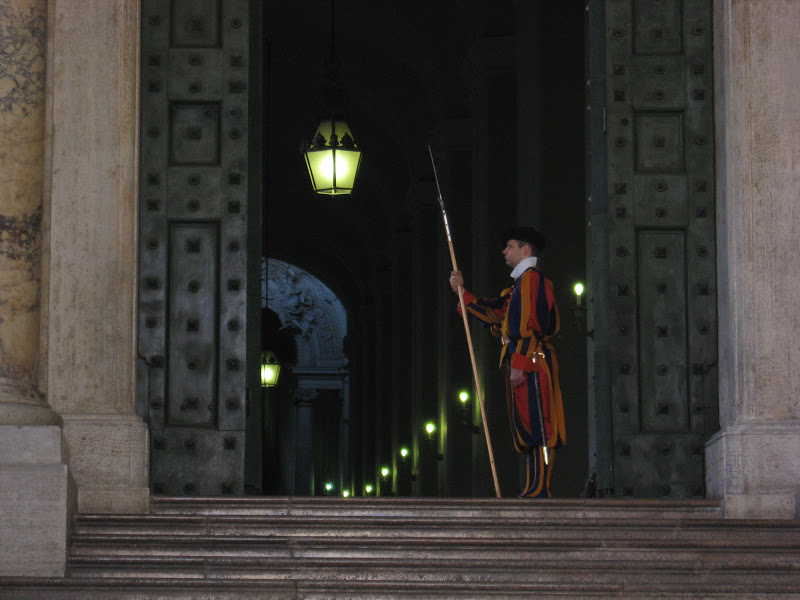
Saint Peter's Basilica is the church located within Vatican City which remains one of the largest churches in the world and is regard as one of the holiest Catholic sites.  In Roman Catholic tradition, the basilica is the burial site of its namesake Saint Peter, one of the twelve apostles of Jesus and, also according to tradition, the first Bishop of Rome and therefore first in the line of the papal succession. Tradition and some historical evidence hold that Saint Peter's tomb is directly below the altar of the basilica.  The dome of St. Peter's rises to a total height of 136.57 meters (448.1 ft) from the floor of the basilica to the top of the external cross. It is not only the highest building in Rome, but the tallest dome in the world.

The Pietà (1498–1499) is another masterpiece of Renaissance sculpture by Michelangelo, housed in St. Peter's Basilica.  It is the only piece Michelangelo ever signed, which depicts the body of Jesus on the lap of his mother Mary after the Crucifixion.

Vatican City is an impressive place to visit (it is actually its own country).  The history, numerous artifacts and frescos in the museum, Sistine Chapel, St. Peter’s Basilica and Square, leaves your mind overwhelmed with information, but definitely worth the wait in long lines (which were much shorter than during the peak summer travel).