Sunday, 4 November 2012

Happy 500th Birthday


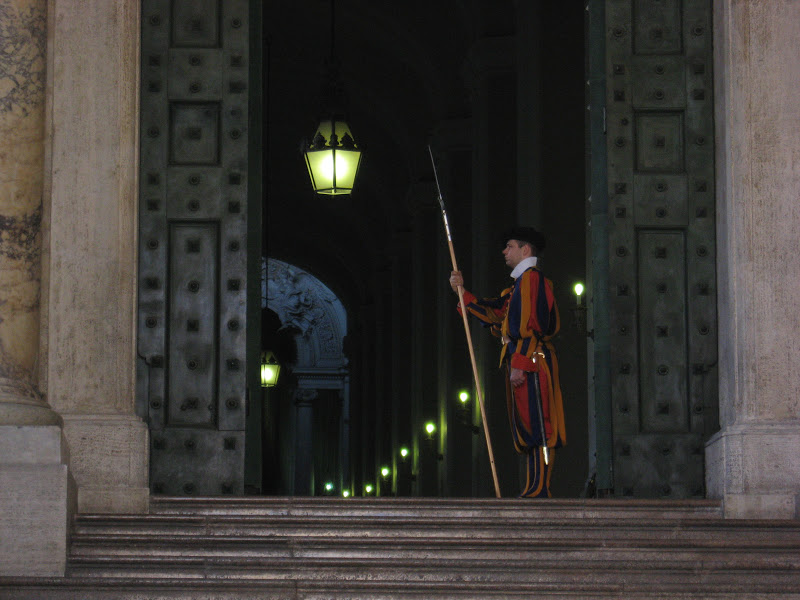
Ascending up the final steps of the stairway, I could sense the growing excitement of the crowd.  Throughout the day, ones mind becomes overwhelmed with numerous sculptures and frescos, with the anticipation of the final room keeping everyone moving forward.  Walking into the chapel, you are immediately drawn to the work of art spread across 1,100 square meters (12,000 square feet).  Due to the age (500 years old on Nov 2) and sensitivity of the paint to dust, heat, and light, the room is air conditioned, and the windows are covered.

Arguably the most famous chapel in the world, the Sistine Chapel lies within the Apostolic Palace, the official residence of the Pope in the Vatican City.  Michelangelo Buonarroti was commissioned by Pope Julius II in 1508 to repaint the ceiling of the Chapel.  While it was originally painted as golden stars on a blue sky, Michelangelo was commissioned to paint only 12 figures, the Apostles. He turned down the commission because he saw himself as a sculptor, not a painter. The Pope offered to allow Michelangelo to paint biblical scenes of his own choice as a compromise. After the work was finished, there were more than 300 figures displaying the creation, Adam and Eve in the Garden of Eden, and the Great Flood.  The ceiling work was completed between 1508 and November 2, 1512, with The Last Judgment being painted by Michelangelo between 1535–1541. For 500 years, the ceiling has withstood the test of time, through natural disasters and conflicts, and is widely believed to be Michelangelo's crowning achievement in painting. 

One of the primary functions of the Sistine Chapel is as a venue for the election of each successive pope in a conclave of the College of Cardinals. On the occasion of a conclave, a chimney is installed in the roof of the chapel, from which smoke arises as a signal. If white smoke appears, created by burning the ballots of the election, a new Pope has been elected. If a candidate receives less than a two-thirds majority, the cardinals send up black smoke—created by burning the ballots along with wet straw and chemical additives—it means that no successful election has yet occurred.

Visited by over 5 million people last year (15,000 per day), the Vatican Museums are among the greatest museums in the world, displaying works from the immense collection built up by the Roman Catholic Church throughout the centuries, including some of the most renowned classical sculptures and most important masterpieces of Renaissance art in the world.  The four Raphael's rooms in the Palace of the Vatican form a suite of reception rooms, the public part of the papal apartments. They are famous for their frescoes, painted by Raphael and his workshop. Together with Michelangelo's ceiling frescoes in the Sistine Chapel, they are the grand fresco sequences that mark the High Renaissance in Rome.

Saint Peter's Basilica is the church located within Vatican City which remains one of the largest churches in the world and is regard as one of the holiest Catholic sites.  In Roman Catholic tradition, the basilica is the burial site of its namesake Saint Peter, one of the twelve apostles of Jesus and, also according to tradition, the first Bishop of Rome and therefore first in the line of the papal succession. Tradition and some historical evidence hold that Saint Peter's tomb is directly below the altar of the basilica.  The dome of St. Peter's rises to a total height of 136.57 meters (448.1 ft) from the floor of the basilica to the top of the external cross. It is not only the highest building in Rome, but the tallest dome in the world.

The Pietà (1498–1499) is another masterpiece of Renaissance sculpture by Michelangelo, housed in St. Peter's Basilica.  It is the only piece Michelangelo ever signed, which depicts the body of Jesus on the lap of his mother Mary after the Crucifixion.

Vatican City is an impressive place to visit (it is actually its own country).  The history, numerous artifacts and frescos in the museum, Sistine Chapel, St. Peter’s Basilica and Square, leaves your mind overwhelmed with information, but definitely worth the wait in long lines (which were much shorter than during the peak summer travel).


Sunday, 30 September 2012

Wine Time


  The rays from the sun beat down on upon the field, and while I kept cutting the numerous strands of grapes, I thought to myself this might be something I can enjoy in retirement (even though retirement is 30+ years away).  The process of making wine seemed intriguing, however, my lesson was just beginning at the end of the summer harvest, and did not take into consideration all the preparation and active management that is done throughout the season to ensure a good grape.  Even with full dedication and long hours during the spring and summer, you are not guaranteed a successful season.  Factors outside your control including mother nature, the type of dirt or irrigation of your land, and even your vine neighbor’s maintenance and gardening skills will affect the dynamics of your grape.  During our time in the field, we filled twenty-five 30 liter crates full of grape strands, and learned some important facts about the process.

  First, the level of alcohol in the finished wine is determined by the level of sugar in the grapes from which it is made, and the primary driver in the sugar level is the amount of sunlight.  More sugar means higher alcohol content. Grapes on the side of the vine which receive the bulk of the day’s sunlight, as well as grapes grown further south which see more sun, will contain more stored sugar than those grown in the north or shady side of the branch.  Therefore, northern wines contain a lower level of alcohol, unless additional sugar is added through a process called chaptalization.  However, a natural wine is made only with its natural sugars.  The alcohol content in this batch of grapes will be between 12 and 13 percent.

  With our in-field experience complete, and after a traditional Slovak lunch of duck, pancakes, and of course wine from last years harvest, it was time to continue the wine making process.  The harvested grapes are placed in a clean container, strands and branches separated by a homemade machine, and the grape is slightly crushed. The juice and grapes skins are transferred to a bin where, depending on the type of wine, will settle, before being transferred to another crusher.  This time, we are making white wine, thus we can transfer the partially crushed grapes and juice to the second crusher immediately.  However, had we been making red wine, the juice would have been required to settle in the bin with the grape skins for a few days.  Although it never occurred to me, the reason is quite simple.  Pulp is the liquid center that is made up of mostly water as well as sugars and acids. Regardless of the type of grape (red or green), the color of the pulp of is actually grey or colorless.  The skin of a red grape is arguably the most important ingredient of red wine which is responsible for the red wine’s distinct color spectrum. Because the pulp of the grape is colorless, the tannins and color compounds of the skin are necessary to give red wine its beautiful color. The pigment is transferred into the wine when the skins are left with the juice during the initial fermentation through a process called maceration.  The individual wine’s particular red hue will depend on the grape type used in the process and the length of time the skin’s pigmentation is in contact with juice. 


  Yeasts, which are necessary to produce alcohol, exist naturally in the vineyard and live on the grape skins. As soon as the skin of the grape is broken, fermentation begins. Once the grapes have been crushed, these yeasts interact with the sugar in the grape juice to produce alcohol (“fermentation”).  Yeast strains vary widely from place to place and contribute significantly to the odor of the finished wine. The yeasts indigenous to a particular area are an important part of what gives its wines their character.  Conventionally grown grapes have little or no wild yeast living on their skin.  Fermentation will continue until all the sugar has been turned into alcohol or the level of alcohol in the juice reaches around fifteen percent, whichever is sooner.  At fifteen percent alcohol, the yeasts will die naturally and any left over sugars will remain in the wine.

  After crushing the grapes a second time by hand using a machine which my friends great grandfather actually used for making wine that looked similar to a wooden barrel (we are making white wine, not red), and then transferring the liquids to oak (not pine) and stainless steel barrels, the fermentation process can continue.  Note that the storage container is very important, and will affect the wine’s maturation, to the extent that grapes from the same vineyard will produce vastly different wines when stored in different types of containers.  The grape juice will be stored for a few months, and through fermentation, will become a tasty white wine for all to enjoy.

Bottle Corker


Holder Tractor built in 1959 (and running well)

Monday, 24 September 2012

Sports/Activity Day


  Cautiously calculating each step, the gusting winds were going to make this obstacle course a challenge.  Narrow balance beams, tires and planks suspended by ropes, which any and every bit of movement sent the platform in a different direction.  While this might sound like any ordinary obstacle course, it was suspended 10 meters (30 ft) above the ground (scary that I am finally starting to understand meters, liters, and Celsius).  And with each turn, I would have to adjust the safety harnesses to the new direction.  The course was fun, but the 8 suspended tires, and moving platform which required you to swing onto by a rope Indiana Jones style, were made more challenging by swirling winds.  In our first timed run with the team, we experienced some delays, as we needed to become familiar with the course but on the second try, I fared much better.

  The next challenge took us over to the paint ball course where our team of 10 would face one of the other center teams in a game of capture the flag.  Immediately as the whistle sounded, I sprinted to the small hill which housed the flag.  By now, paint balls were crisscrossing all throughout the course, and I was really not ready to start and be pelted from every direction.  I crouched against the hill while constantly monitoring both sides as the enemy approached.  I felt if we were going to win the first game, it would be now or never to attempt to take the flag.  Rising to my feet, and climbing to the top of the small hill, the flag was no where to be found.  Through my hesitation, the other team had quietly run off with the flag, even as I lay nearby.  However, the flag did not make it far, as it was dropped near a makeshift shelter.  As I crept closer to the prize, I felt three pinches and had green paint splattered across my mask.  While we lost the first game, we did win the second, and the third game became an all out “use all your paint balls regardless of how many times you get hit” brawl.  The rest of the day’s activities consisted of football (soccer…which I am a terrible goalie), sand volleyball, 4x4 wheel driving, and finally, a giant 20 meter swing/drop.  And of course, there was good food and beer to enjoy the day with the team and other center members.  In all, we had about 250 people, and everyone had a great time, especially since Slovakia won their hockey game against Canada to advance to the semi-finals.

  Finally, it seems I have found the new favorite food of the office which everyone has enjoyed.  As a standard staple for most American diets, similar to peanut butter with jelly, or burgers with fries, chips and a dip are a required combination.  And while I have not found any Dean’s French Onion dip, avocados are plentiful, and my guacamole recipe has been a huge success.  While I am not sure what the traditional use of the avocado is in Slovakia, taking a couple avocados, a tomato, onion, red pepper, lime juice, and adding a prepackaged mix brought from the US, the dip has become a favorite of many.  To take the tasty snack to another level in flavor country, I started making cheese quesadillas which become an instant hit.  Now I need to convince family and friends who visit me to carry onto the plane a suitcase full of guacamole mix.

Thursday, 23 August 2012

Greetings from Győr


Photo from the internet; not my feet :-)
Sensing eager appetites, I slowly dipped my feet into the water, and instantly felt the tingling sensation became greater, soon occurring all around both of my feet.  Between toes, and on the soles of my feet, I fought the urge exit quickly from the fish doctor’s office.  Believed to have originated from Turkey, fish massages have become quite popular in Asian cultures (and is actually banned in 15 US States), and claim to be good for your health because fish nibbling dead cells stimulates nerves and assists blood circulation.  Although I am unsure if this experience was effective, if was definitely odd, and did make me cringe at times.  However I do not feel I am ready for the full body fish massage that is offered at other locations.

Located 1 hour outside of Bratislava, the city of Győr, Hungary lies halfway between Vienna and Budapest.  During the Ottoman occupation of in the late 17th century, Győr's commander thought it would be futile to try to defend the town from the Turkish army, so he decided to burn the whole town instead.  The Turks found nothing but blackened ruins, and give the city the nickname Yanık kale or "burnt city".  Eventually, the town was rebuilt and surrounded with a castle and a city wall, with lots of new buildings built in Renaissance style.  Today, the population of Győr is about 130,000, supported by a large Audi manufacturing plant, and small university.  While the city is tiny, it definitely has a charming atmosphere, with the square packed with numerous outdoor restaurants and ice cream stations.  Also located in the town is a large water park which was perfect to cool off on a warm summer day.  While I was consistently slow racing down the water slides, I did manage to swim 5 whole laps (100 meters each), although not consecutively but rather over an hour period as I still need long rests between, but improving.  The weekend trip was definitely a nice and relaxing, and I am looking forward to visiting again in the winter time to enjoy the hot springs, but I will probably pass on becoming fish food. 


Thursday, 2 August 2012

On your mark, Get set, Go!


  The wheels screeched against the pavement with every tight turn around the arena.  As I pressed further down on the gas pedal, I felt a slight nudge from behind.  While I thought I was in a competitive battle with my colleague, apparently others behind felt I was holding back the pack.  As I have witnessed, Europeans, especially Slovakians, are very competitive and aggressive drivers, and the go kart track is no different.  Even with a pair of racing gloves and a helmet, I was not ready to push the kart to the level of competition which others desired. Furthermore, without any seat belt, I believe the helmet was actually wearing me for protection.  Although I have not driven on many courses, this was by far the best, with challenging turns well padded for any incident; the races were very safe races and a lot of fun.  Even with limited driving experience over year, I managed to stay in the middle of the pack, breaking the 50 second mark for a lap once while the leaders were consistently in the 46-48 seconds per lap range. 

  After the completion of the races, the team gathered at one of the outdoor restaurants at the nearby lake.  While some decided to head for a swim to cool off, I was not ready to jump into a lake with high voltage power lines crossing above.  We enjoyed traditional Slovak sausages with mustard and fried dough, but my event planning strategy could use some improvement.  My original thought of holding a team event on the 4th of July US Holiday was so that we could leave work early to enjoy the day. And that happened, however, we all needed to be in the office the next day, and with team events running late into the night, the homemade wine, which tasted great, kept flowing and Croatian shots, which tasted terrible, kept being toasted.  The next day was very long at the office, with very little appetite for lunch.  Everyone on the team had a great time, and we are all looking forward to the next event.

  Finally, after successfully identifying 15 of 16 candies from a candy line-up (no, it was not a set-up with all samples being a Twix bar), I consider myself to be a candy expert and I think most of the friends and family will agree that sugar is a staple of my diet.  I also know that they changed the $100,000 Bar to 100 Grand, and that most candy commercials have swirling chocolate except Skittles.  But in recent weeks, my candy knowledge has taken a step in the wrong direction.  All stores and vending machines in Bratislava have the typical US candy consisting of Snickers, Twix, Skittles, and M&Ms, but no Hershey’s products, although I have my secret store for peanut butter cups.  However, I never could find my current favorite, the elusive Milky Way bar.  I was always intimidated by the Mars bar which is found throughout Europe, because I thought was a dark chocolate, but finally gave it a try.  To my astonishment, the Mars bar in Europe is actually a Milky Way in the US!  And, it turns out that Milky Way bar here, is actually a 3 Musketeers bar, but in a much smaller version and different packaging.

Candy Quiz - I only used the pictures, and not the written description.

The lake, with crossing power lines at the top